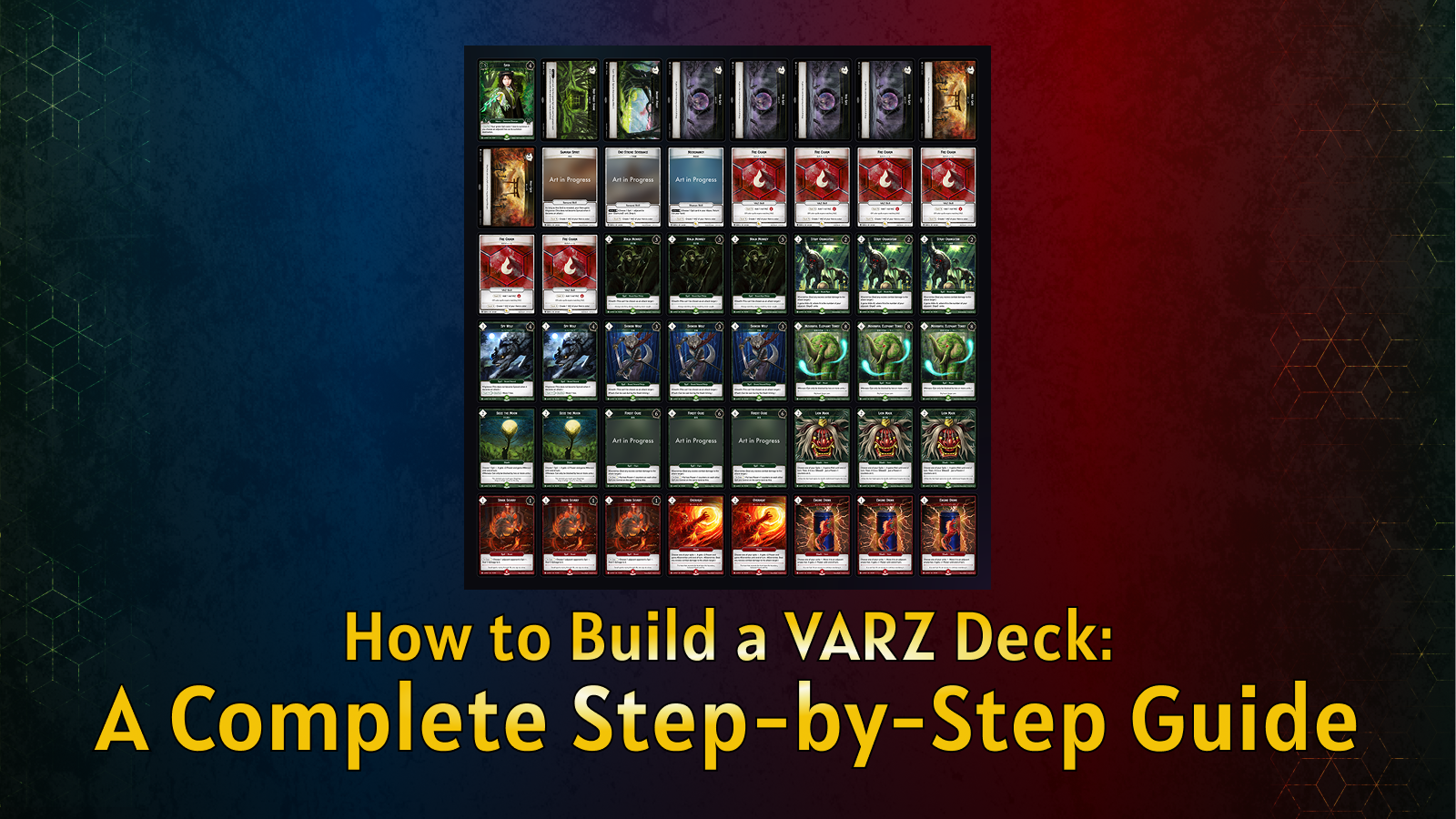
A VARZ deck is not simply a collection of your strongest cards.
It is a plan for creating a specific battlefield, opening a route, protecting your Hero and Portals, and reaching one of VARZ’s two victory conditions.
This guide explains the complete construction process—from choosing a Hero to testing the finished deck—so that a new player can build a playable first list without beginning from a blank screen.
1. Know What a Complete Deck Contains
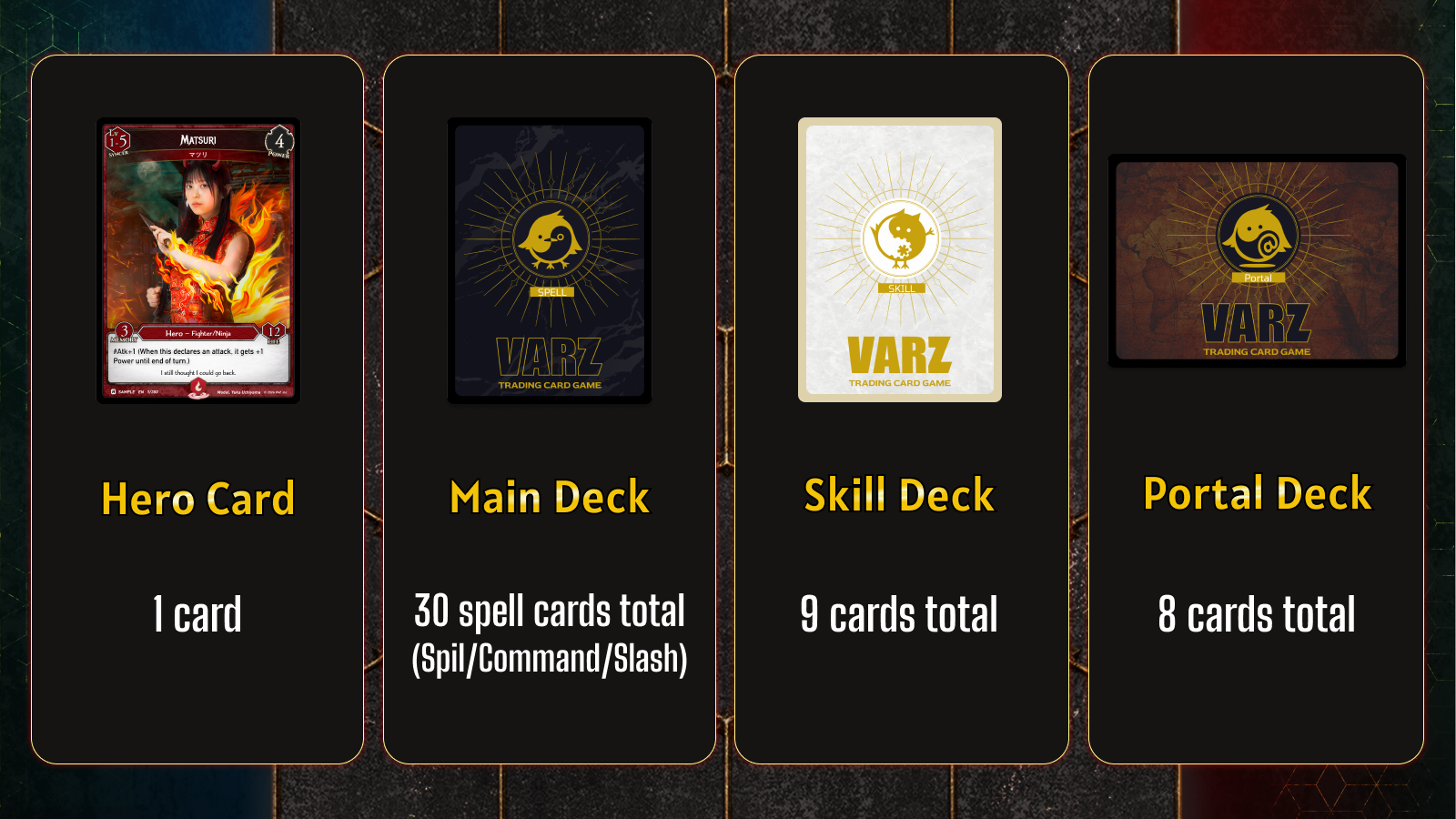
A complete VARZ deck is divided into separate components.
- Hero: 1 card
- Spell Deck: 30 cards
- Skill Deck: 9 cards
- Portal Deck: 8 cards
- Spils: Units summoned onto the hex battlefield
- Commands: Effects generally used during your own available action timing
- Slashes: Reactive effects and cards that can influence an ongoing sequence
Because rules and card data may be adjusted during playtesting, always use the official Deck Builder and latest rulebook as the final legality check.
2. Choose Your Hero First
The Hero is the strategic center of the deck.
Do not begin by selecting thirty independent cards. Begin with one Hero and ask what that Hero helps you do better than another Hero.
Consider:
- Where does the Hero want to stand?
- Does the ability reward attacking, defending, moving, summoning beside the Hero, or controlling a particular type of Spil?
- Does the Hero need allied units nearby?
- Does the Hero want to remain safe, or participate in combat?
- Which color naturally supports that ability?
For a first deck, using one color is the easiest and most consistent starting point.
3. Decide How the Deck Plans to Win
VARZ has two main paths to victory:
- Reduce the opposing player’s Life to 0.
- Destroy all Portals on one of the opponent’s lands.
Life-pressure deck
This deck wants to create access to the opposing Hero, attack repeatedly, and use movement or direct damage to maintain pressure.
It usually needs:
- Fast or mobile Spils
- Ways to remove blockers
- Temporary Power increases
- Attackers that can act immediately
- Protection against counterattacks
Portal-pressure deck
This deck wants to control routes, force defenders away from an objective, and concentrate damage on one land’s Portal line.
It usually needs:
- Units that hold important hexes
- Movement or displacement effects
- Durable attackers
- Direct Portal pressure
- A way to keep its own Hero safe while attacking elsewhere
Control or development deck
This deck wants to survive the early game, gain positional or card advantage, and create a stronger battlefield over time.
It usually needs:
- Defensive Spils
- Card draw or card selection
- Sync, return-to-hand, protection, or removal effects
- A clear finisher that converts control into victory
Example:
“Move quickly through one route, remove the first blocker, and pressure the opponent’s Hero before they complete a defensive formation.”
If a card does not support that sentence or solve a problem the plan faces, it may not belong in the first version of the deck.
4. Choose 8–12 Core Cards
The core cards are the pieces you most want to draw together.
Choose cards that create a repeatable sequence rather than cards that are only individually powerful.
A useful core usually includes:
- One or two early Spils
- One main attacker or board-control unit
- One movement or positioning tool
- One card that protects or supports the plan
- One card that creates the finishing turn
Example: Red pressure core
A Red deck led by Matsuri could begin with roles such as:
- Ember Scamper: Early #Haste pressure
- Engine Drink: Movement plus temporary Power
- Wanyudo: Converts movement distance into attack pressure
- Red Ogre: Breaks a dense formation
- Mirage: Replaces a used Spil with a fresh #Haste attacker
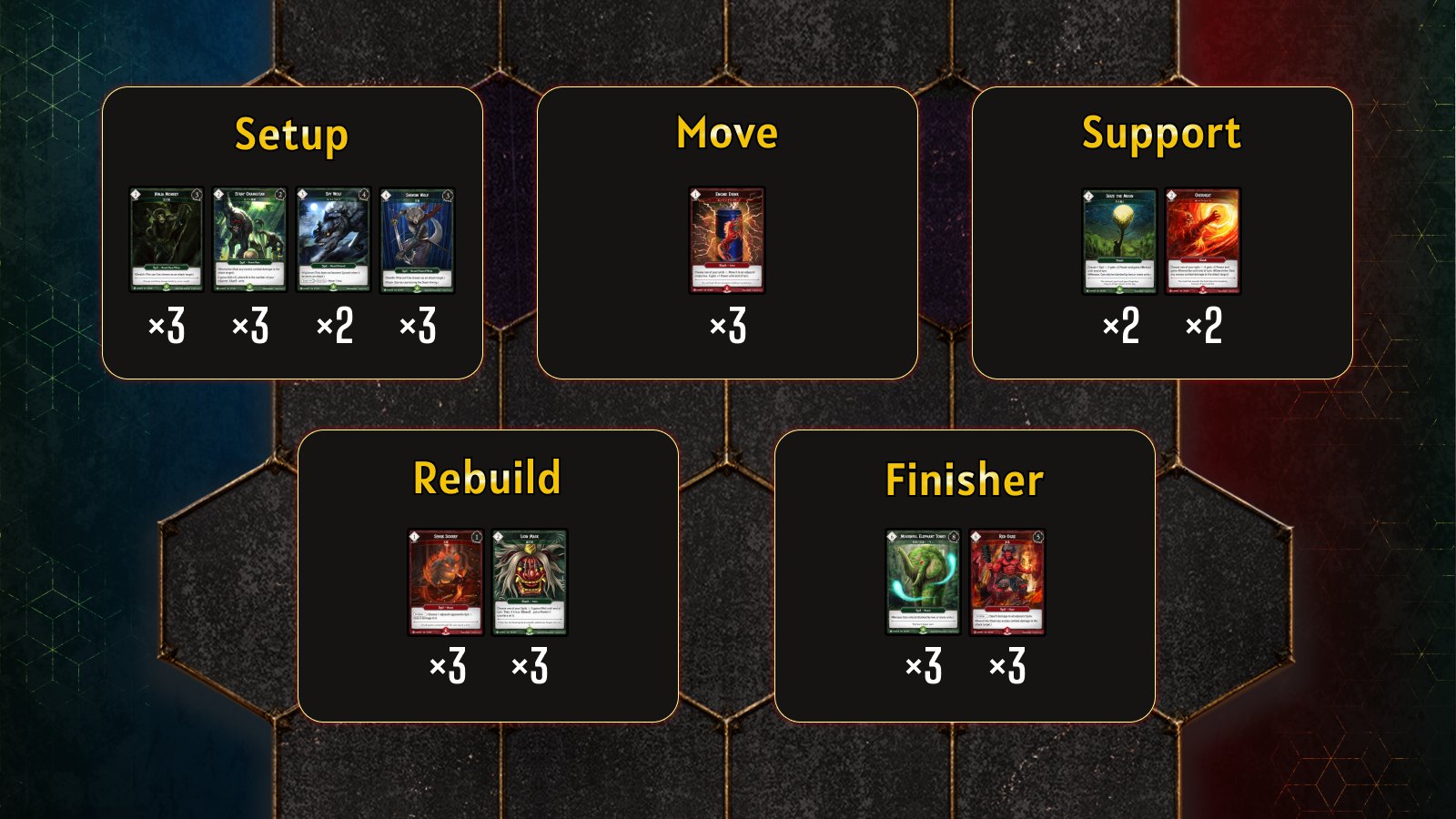
5. Fill the 30-Card Spell Deck by Role
After choosing the core, fill the remaining slots by role.
A practical first-draft template is:
- 18–22 Spils
- 8–12 Commands and Slashes combined
Within those cards, make sure the deck contains the following jobs.
Early setup
Cards that can enter play before the opponent controls every useful hex.
Their role may be to:
- Occupy a route
- Stand beside the Hero
- Protect a Portal
- Prepare an adjacency effect
- Force the opponent to respond
Movement and access
Cards that help your units reach the right hex or change the opponent’s position.
A deck with strong attackers but no route toward the objective can lose without using its Power effectively.
Interaction
Cards that answer an opposing threat.
Examples include:
- Direct damage
- Sync
- Return to hand
- Forced movement
- Power reduction
- Protection
- Banish or Drop effects
Recovery
Cards that remain useful when your original plan fails.
Include ways to:
- Rebuild the battlefield
- Protect a threatened Portal
- Replace a dropped unit
- Draw or recover cards
- Reposition the Hero
Finishers
Cards that turn an advantage into a win.
A finisher may be a high-Power Spil, a wide Power increase, a board reset, direct Portal damage, or an effect that creates a final attack route.
Do not include too many finishers. A card cannot finish the game if the deck never establishes the battlefield required to use it.
6. Check the Cost Curve
A deck containing too many expensive cards may spend the early game watching the opponent take control of the battlefield.
A deck containing only low-cost cards may establish a position but fail to finish the game.
For the first draft, spread the Spell Deck across three broad groups:
- Low cost: Cards that establish the first positions
- Middle cost: The main body of the deck and its repeatable actions
- High cost: Finishers, board resets, and major threats
- 9 low-cost cards
- 13 middle-cost cards
- 8 high-cost or situational cards
When reviewing the curve, ask:
- Can I normally play something useful early?
- Do I have too many cards competing for the same turn?
- Can I perform two smaller actions instead of one large action when necessary?
- Are my expensive cards still useful when I am behind?
7. Build the Skill Deck and Plan Your VAZ
VAZ is color-specific.
Your Hero’s color is the reliable base because all Skills can generate VAZ of that color.
To use a card of another color, you must prepare matching VAZ through the Skill Deck. A Blue card with a cost of 3 requires three Blue VAZ, even when the deck’s Hero is Red.
This creates an important construction tradeoff:
- One color: More consistent and easier to operate
- Multiple colors: More options, but requires more Skill Deck planning
Add a second color only when you can clearly answer:
- Which exact off-color cards improve the deck?
- At what point in the match must I generate that color?
- Will drawing the card without the matching VAZ create a dead hand?
- What Hero-color card could perform a similar role more consistently?
8. Choose Eight Portals That Support the Plan
The Portal Deck is part of the strategy, not a decorative extra.
Choose eight Portal cards while considering:
- Which effects support your preferred land or formation?
- Does the deck benefit from protecting Portals for a long time?
- Can it use a Portal’s effect before the opponent destroys it?
- Does the Portal setup create a weakness on the land your Hero must defend?
- How will the deck respond after a Portal is destroyed and the next one is revealed?
Test the Portal Deck together with the Spell Deck. A strong Portal in isolation may still create the wrong battlefield for the Hero and Spils you selected.
9. Build the Deck in the Official Deck Builder
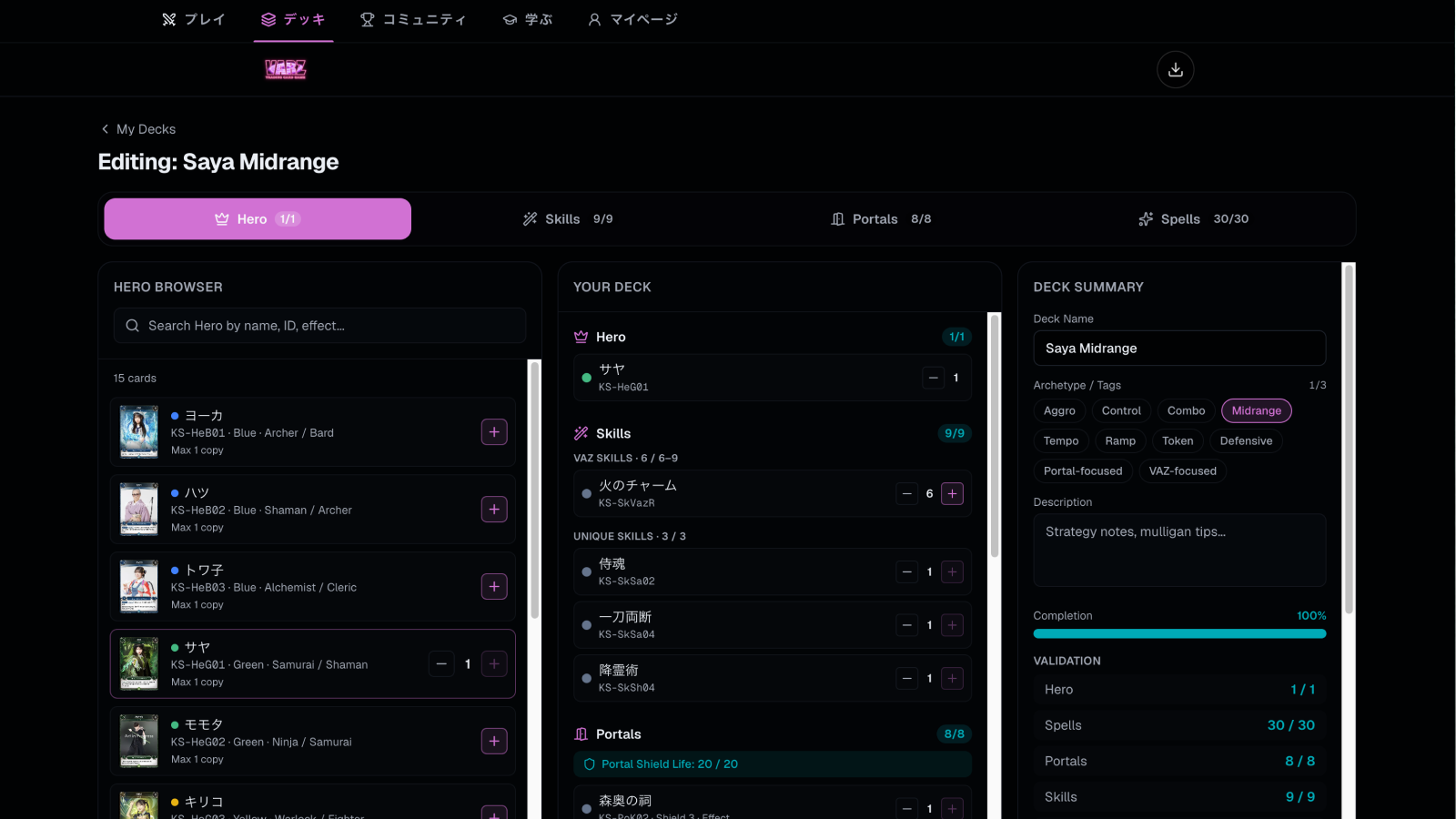
Once the plan is clear, enter the list into the official VARZ Deck Builder.
Use the builder to:
- Filter cards by color, type, class, cost, or keyword
- Confirm the total number of cards
- Check duplicate limits and construction requirements
- Review the deck’s cost distribution
- Save and share the list
- Prepare the current supported method for Tabletop Simulator play
10. Perform a Final Deck Check
Before the first match, confirm the following.
Legality
- 1 Hero
- 30 Spell cards
- 9 Skill cards
- 8 Portal cards
- Copy limits and current format restrictions are satisfied
Strategy
- The primary victory plan can be explained in one sentence
- The deck has a way to reach the intended target
- The deck contains enough units to occupy the battlefield
- The deck can protect its own Hero and at least one important Portal route
- The deck has a finishing sequence
Consistency
- Essential cards use enough copies to be drawn regularly
- Situational cards do not occupy too many slots
- The cost curve contains useful early plays
- Any off-color card has matching VAZ support
Recovery
- The deck can continue after losing its first attacker
- It contains an answer to a large enemy Spil
- It contains an answer to an important support Spil
- It can recover when the opponent changes the target from Life to Portals
11. Test Three Matches Before Rebuilding
One match can be decided by unusual draws or an unfamiliar matchup.
Play at least three matches before changing the entire deck.
After each match, record only a few observations:
- Which card remained unusable in hand?
- Which card did you repeatedly wish you could draw?
- Did the deck fail because of card strength or because the required hex was unavailable?
- Did the Skill Deck produce the VAZ you needed?
- Did you lose access to the Hero or Portal because every unit moved forward?
Small changes make it easier to understand what improved. Replacing half the deck at once creates a new deck and removes the information gained from testing.
Common Deck-Building Mistakes
Adding every powerful card
Powerful cards may need different colors, positions, timing, or support. A connected plan is more reliable than a collection of unrelated finishers.
Ignoring movement
Attackers need a route. Include cards that move your units, change opposing positions, or punish the opponent for occupying a particular shape.
Using too many high-cost cards
If every exciting card belongs to the late game, the opponent may decide the battlefield before you can use them.
Building only for the ideal opening
Include cards that help when the first attacker is removed, the Hero is displaced, or a Portal is attacked earlier than expected.
Adding another color without enough VAZ
An off-color card is not part of the deck until the Skill Deck can reliably pay for it.
Changing too many cards after one loss
Identify the repeated problem first. The result of one match is not enough information to rebuild the entire list.
The Simplest Way to Begin
The complete process can be reduced to seven steps:
- Choose one Hero.
- Choose one primary color.
- Write one sentence describing how the deck wins.
- Select 8–12 core cards that create that plan.
- Complete the 30-card Spell Deck by adding setup, movement, interaction, recovery, and finishers.
- Build the Skill and Portal Decks around the same plan.
- Test three matches and change only a few cards.
It needs to produce its intended battlefield often enough for you to learn what the strategy needs next.
Open the VARZ TCG official website